Fed chiefs swim against dovish tide, trade-war damage piles up, and another an oil-market warning. Not so fast..Markets have a July rate cut from the Federal Reserve as the base case following Chair Jerome Powell's two-day testimony to Congress. Two regional Fed governors are pushing back, with Atlanta's Raphael Bostic and Richmond's Thomas Barkin disputing the need for stimulus right now. Each of them cited the Dallas Fed's trimmed mean measure of inflation which has come in close to 2% in recent months. As neither of them are voting on the FOMC this year, their arguments could well get lost as Powell gets on with being the world's central banker. SlowdownThe fallout from the trade war is becoming clearer. Export-reliant Singapore's gross domestic product unexpectedly shrank an annualized 3.4% in the second quarter, the biggest decline since 2012. China's exports slowed more than forecast, and imports plunged 7.3% overall -- down a whopping 31.4% with the U.S. The latter may reflect the lack of agricultural purchases. There were also warnings from Switzerland this morning on the damage being done to the country's export sector. SlowerOPEC and its allies agreed to extend production cuts into 2020 earlier this month, and already the International Energy Agency is saying that they may need to reduce production even more as the market has returned to surplus. The fall-off in global oil demand is only adding to the risks of another glut in the near future. Despite the warnings, crude is trading higher today, with a barrel of West Texas Intermediate for August delivery firmly over $60 as investors are more concerned about the immediate threat of a Barry-induced production shutdown and tensions in the Middle East. Markets rise Overnight, the MSCI Asia Pacific Index slipped 0.2% while Japan's Topix index closed 0.2% lower as weaker-than-forecast earnings hit the electronics sector. In Europe, the Stoxx 600 Index was 0.2% higher at 5:45 a.m. Eastern Time with a rebound in mining and chemical shares leading the gain. S&P futures pointed to green at the open, the 10-year Treasury yield was at 2.141% and gold was higher. Coming up…It's a quiet end to a busy week, with U.S. producer price inflation for June forecast to show a small decline when the number is published at 8:30 a.m. Federal Reserve Bank of Chicago President Charles Evans is the only monetary-policy speaker today. Already-busy watchers of the oil market have the Baker Hughes rig count at 1:00 p.m. What we've been readingThis is what's caught our eye over the last 24 hours. And finally, here's what Luke's interested in this morning20/20 Hindsight Capital here: As soon as negative-yielding European junk bonds made it to the front page, the "everything rally" across asset classes had to come to an end. The irony is that to keep the cross-asset narrative intact – global activity is gloomy but not dire, and central banks are coming to the rescue to ensure it doesn't get worse – it's the longer-term risk-free sovereign bonds that have borne the brunt of the adjustment process. And not European high-yield companies whose debt is trading with yields below zero. This week has seen the beginnings of duration risk, rather than credit risk, falling out of favor in the marketplace. It's the bonds, not the corporates, that have been the issue. Between firmer than expected U.S. job growth and core CPI inflation and a pop in French industrial production, both American and German 10-year yields have risen nearly 20 basis points since last Friday. If the world isn't falling apart but central banks are still easing, there's a limit to how much longer-term yields should fall. The probability attached to tail risk scenarios involving a return to the zero lower bound in the U.S., and the potential for deflationary spirals, ought to diminish. With the market pricing at least one Fed cut coming soon and other major central banks expected to add accommodation in coming months, this dynamic offers a bullish backdrop for risk assets. A look at forward curves suggest the world's preeminent long-term, risk-free asset – Treasuries – is expected to continue to be among the first casualties of the end of the everything rally. Equity bulls ought to be thrilled by the idea that U.S. stocks can hit fresh records even amid a reversal in the tumbling long-term yields that had been juicing valuations. This dynamic, if sustained, allows for good economic news to be good news for risk assets, so long as earnings hold up! 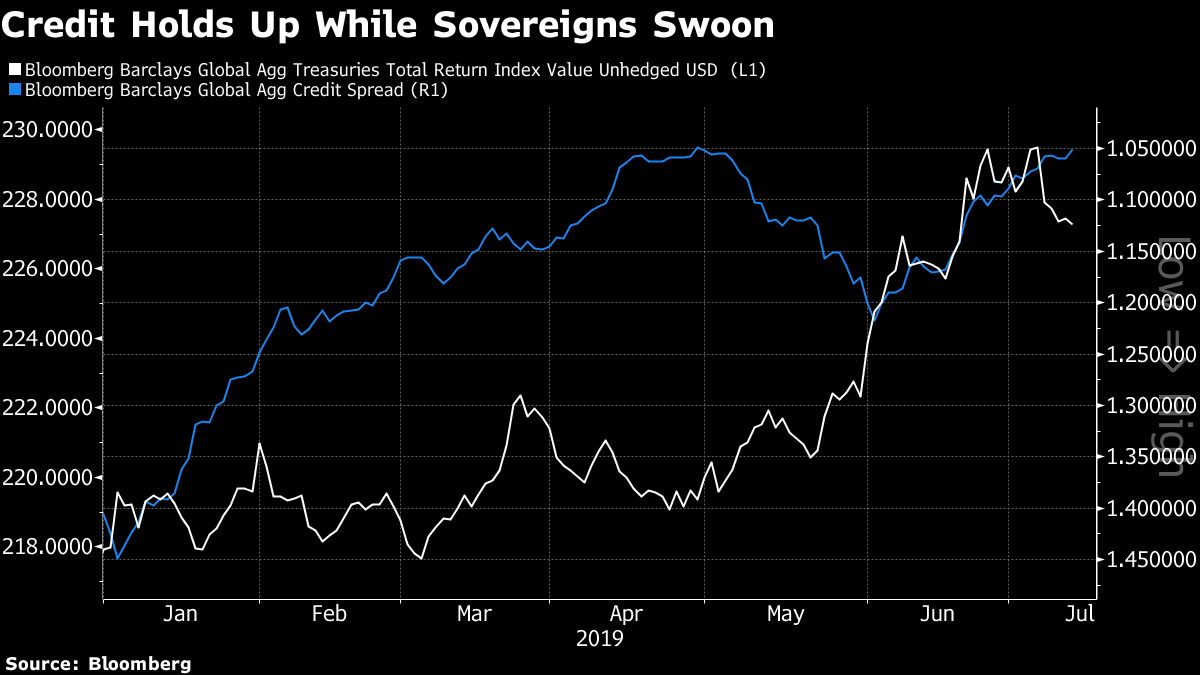 Like Bloomberg's Five Things? Subscribe for unlimited access to trusted, data-based journalism in 120 countries around the world and gain expert analysis from exclusive daily newsletters, The Bloomberg Open and The Bloomberg Close. Before it's here, it's on the Bloomberg Terminal. Find out more about how the Terminal delivers information and analysis that financial professionals can't find anywhere else. Learn more. | 


Post a Comment