| Hong Kong demonstrations, trade tensions and the leadup to the Federal Reserve's meeting this week. Here are some of the things people in markets are talking about today. Protest Momentum Hong Kong rose up in defiance a day after leader Carrie Lam suspended a contentious extradition bill, jamming the streets with hundreds of thousands of people and drawing a formal apology from the embattled chief executive. Protesters wanted the complete withdrawal of the bill, which opponents say threatens the former British colony's tenuous autonomy from Communist Party-ruled China. The largely peaceful crowds showed up in significantly larger numbers even after Lam announced Saturday she was suspending efforts to pass the legislation. Here are some photos from the protest. Keeping Expectations Low Commerce Secretary Wilbur Ross downplayed the prospect of a major trade deal emerging from a possible meeting between President Donald Trump and Chinese President Xi Jinping at the Group of 20 summit in Osaka, Japan, this month. That's after Trump said Friday that "it doesn't matter" if he gets a meeting with Xi at the G-20. "If he shows up, good," Trump told Fox News. "If he doesn't -- in the meantime, we're taking in billions of dollars a month. Eventually, they're going to make a deal, because they're going to have to." However, Trump also reportedly delayed a speech by his vice president criticizing China's human-rights record to avoid upsetting Beijing ahead of potential talks. Energy Tensions Saudi Arabia's crown prince blamed Iran for last week's attacks on tankers near the Strait of Hormuz, adding to accusations that are stoking tensions in a region supplying a third of the world's oil. There's "no doubt" Iran was responsible for attacks on two oil tankers leaving the Persian Gulf last week, and the U.S. will guarantee safe commercial navigation going forward with its partners, Secretary of State Michael Pompeo said. G-20 energy ministers who met in Japan over the weekend highlighted the importance of energy security in a communique issued at the end of the conference. And oil-tanker owners face spiraling insurance costs to load cargoes from the world's largest crude-export region after the latest round of attacks on vessels. Forcing BOJ's Hand? A majority of economists now see the Bank of Japan expanding stimulus as its next move, with a strengthening of the yen thanks to Federal Reserve interest-rate cuts seen as a key factor for triggering action, according to a Bloomberg survey. While all 50 polled economists expect no policy change at the two-day meeting ending on June 20, 62% of them think the central bank will ramp up easing measures as its next step, compared with 48% in April, the survey showed. Awaiting the Fed Chairman Jerome Powell's frequent assurance that sustaining the U.S. economic expansion is the Federal Reserve's "overarching'' goal is opening the door to potentially aggressive interest-rate cuts. The timing, size and whether such moves are indeed in his plans may become clearer when Powell and his colleagues meet on Tuesday and Wednesday in Washington. Meanwhile, former Fed Vice Chairman Stanley Fischer predicted President Donald Trump won't renominate Powell for another term as chairman if re-elected, undercutting the Fed's autonomy. What we've been reading This is what's caught our eye over the last 24 hours. And finally, here's what Cormac's interested in this morning The recent rebound in U.S. stocks is not being backed up by a popular gauge of economic growth expectations. The ratio of copper prices to gold has fallen back toward its two-year low this month while the S&P 500 Index has climbed to within 2% of its all-time high, according to data compiled by Bloomberg. Expectations for rate cuts from the Federal Reserve may be underpinning stocks, which have diverged from the growth proxy, RBC Capital Markets strategist George Davis suggested in a note to clients last week. 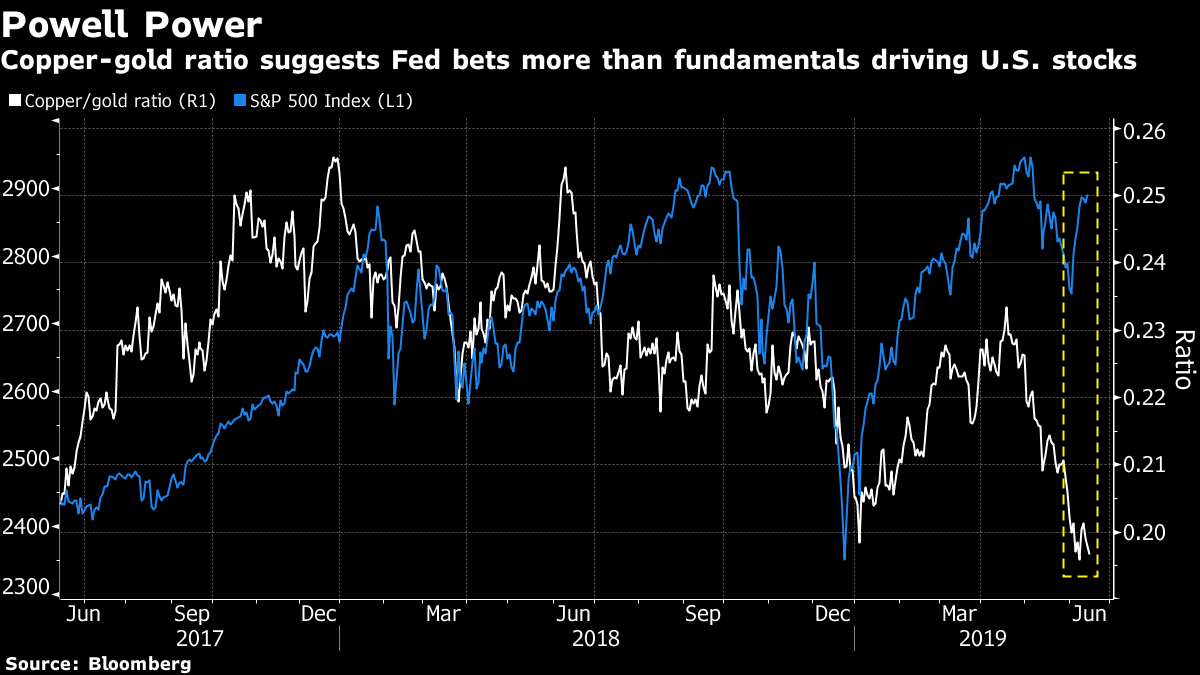 The divergence is further evidence of how much is now riding on the actions of the Fed over the next month or so, starting with their June meeting this week. Traders will be closely watching the language in the statement for signs their rate cut expectations (at least 50 basis points by October) will be met. Any evidence to the contrary could provide a nasty shock to equity bulls, as stocks get pulled back down in line with a gloomy outlook for growth. Cormac Mullen is a Cross-Asset reporter and editor for Bloomberg News in Tokyo. Even before Trump's trade war, China was the world's biggest story. It's reshaping the global economy — but its ascent hasn't come without major problems. Sign up to get Next China, a weekly dispatch on where the country stands now and is headed next. Before it's here, it's on the Bloomberg Terminal. Find out more about how the Terminal delivers information and analysis that financial professionals can't find anywhere else. Learn more. | 


Post a Comment