| Welcome to your morning markets update, delivered every weekday before the European open. Good morning. Trade tensions between the U.S. and China continue to ramp up ahead of the G-20, oil prices remain volatile and Bitcoin's reliving some of its recent glory days. Here's what's moving markets. G-20 Eve The G-20 summit is still a day away but U.S. President Donald Trump has given markets plenty to chew over before he holds talks with Chinese leader Xi Jinping. Trump said he has a plan B for China should the trade talks falter, namely slapping billions more in tariffs on Chinese goods. The question is whether the two can make enough progress towards a deal that they keep talking, avoiding the extra levies. Watch for more comments from both sides ahead of the meeting and note Bloomberg Economics's calculation that if they can reach a deal, it could save the global economy $1.2 trillion. Breach Oil prices dipped a little on Thursday, but note this was after having hit a 5-week high following the biggest drop in U.S. crude stockpiles since 2016. Beyond the supply story, the tensions around Iran remain key for the direction of oil prices. The Middle East country is due on Thursday to breach its 2015 nuclear deal for the first time, putting pressure on European powers to attempt to salvage that agreement in the face of crippling U.S. sanctions on Iran. United Nations members also expressed concern that if Iran doesn't take a step back, it could sleepwalk into war. Stopping that will be another key topic at the G-20. Illiquidity H20 Asset Management, the money manager backed by French bank Natixis SA, is planning to jettison the controversial illiquid holdings which have triggered billions of dollars of withdrawals from its funds in the past week or so. Similar to U.K. fund manager Neil Woodford, it would appear that in a search for yield, funds have been piling into higher-risk assets that are more difficult to offload in a selloff. Bank of England Governor Mark Carney weighed in on the issue but the backdrop is likely to remain the same, with two major U.S. banks now predicting even lower U.S. Treasury yields to come. Deja Vu It's beginning to look a lot like late 2017. Bitcoin is surging, topping the $13,000 mark on Wednesday and taking its gain for the year to around 200%. Crypto-related stocks are following Bitcoin higher, again echoing the stunning price swings seen during the heady days of the previous crypto craze, and the fortune of the Winklevoss twins has doubled. One difference this time? Consumers don't seem to care as much. Short interest in Bitcoin is also at a record high and positions are having to be unwound due to the rise for the asset, so more short-covering is likely to continue to push prices higher. Strap in, folks. Coming Up... Asian stocks investors at least are optimistic that a deal is going to get done, with stocks rising and the Japanese yen falling the most since April. European futures are also pointing to a positive open, following Asia's example. The second part of the Federal Reserve's bank stress test results will be published on Thursday and we'll get economic confidence data for the euro area and inflation data for both Germany and Spain to mull over. What We've Been Reading This is what's caught our eye over the past 24 hours. And finally, here's what Cormac Mullen's interested in this morning While income investors are tearing their hair out at the global slump in bond yields, on the other side of the aisle, issuers are taking advantage. An excellent example is Austria, which sold a tidy $1.4 billion in 100-year debt Wednesday at a yield of just 1.2%. In a sign of our yield-starved times, the sale was more than four times subscribed.The deal shows demand can be found even for ultra-low yielding, ultra-long debt, as investors rush to the security of top-rated borrowers amid growing economic uncertainty. Pension funds and insurers were likely purchasers, using the securities for asset and liability-management purposes. They will have seen that investors in Austria's century bonds launched in 2017, at a yield of around 2.1%, are already sitting on a return of over 50%. A repeat performance at almost half that yield is no guarantee. 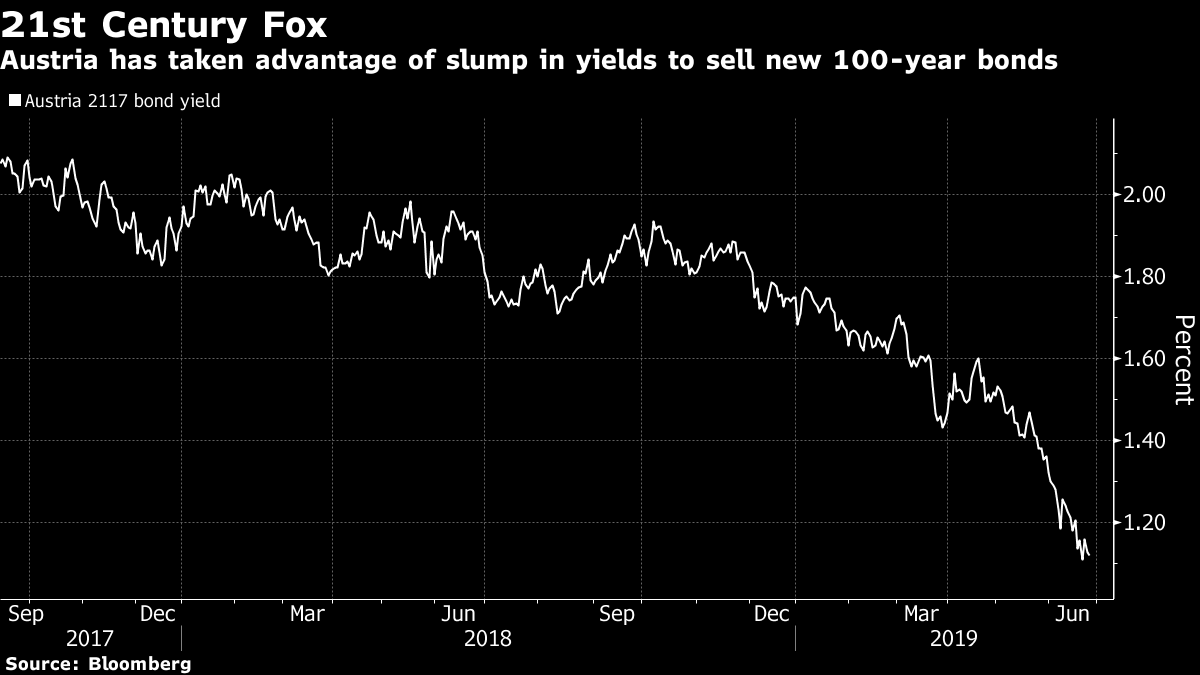 Cormac Mullen is a Cross-Asset reporter and editor for Bloomberg News in Tokyo. Like Bloomberg's Five Things? Subscribe for unlimited access to trusted, data-based journalism in 120 countries around the world and gain expert analysis from exclusive daily newsletters, The Bloomberg Open and The Bloomberg Close. Before it's here, it's on the Bloomberg Terminal. Find out more about how the Terminal delivers information and analysis that financial professionals can't find anywhere else. Learn more. | 


Post a Comment