Trade and policy battle for investor attention, 2 million people flood the streets of Hong Kong, and it's the Paris Air Show. Here are some of the things people in markets are talking about today. Trade vs. central bankersWith rate decisions in the U.S., the U.K. and Japan this week to name just a few, focus will understandably be on policy makers in the coming days. Yet truth be told no changes are expected, so is it really where we should all be looking? Trade remains the less-predictable factor in the fate of many assets. On Monday, public hearings begin in Washington on President Donald Trump's proposed tariffs on $300 billion more in Chinese goods. At the same time, Tariff Man's re-election campaign has reportedly severed ties with some of its pollsters after the leak of months-old surveys showed him trailing former Vice President Joe Biden in key states. These feel like the kind of circumstances when he usually likes to send a strong message… Meanwhile, U.S. Commerce Secretary Wilbur Ross told Bloomberg TV a lack of clarity after the European Parliament elections means that EU-U.S. talks on auto tariffs are on hold, Intel Corp. said this weekend it's reviewing its supply chains, and India has imposed higher customs duties on a raft of U.S. goods. Eyes on the ball, people. 2 millionIf there was any doubt at all as to the scale of resistance to Hong Kong's proposed new law, which for the first time would allow extraditions to China, this weekend dispelled it. An estimated 2 million people shut down the center of the city on Sunday in protest at the bill that is currently suspended -- they want it scrapped entirely. Here's what a protest of that size looks like. While the move to put the bill on ice helped support market sentiment and the Hang Seng rose on Monday, all this is heaping pressure on Hong Kong's embattled leader Carrie Lam despite there being no clear replacement if she were to step aside. Given the disquiet, it seems an awkward time for the U.K. to be touting its new connection to the Shanghai stock exchange. But that's life. Plane-a-paloozaIt's the Cannes of the aviation world, Woodstock for plane spotters, the Davos of the… ah you get the idea. Yep, the Paris Air Show is happening and as you can imagine it's a bigger deal than usual for Boeing Co., what with one of their flagship models still grounded following two fatal crashes. And the Chicago-based company is already off to a rough start, with early reports that rival Airbus SE won an aircraft megadeal from Air Lease Corp. and is close to pocketing $4.1 billion for an order of 14 planes from Virgin Atlantic Airways Ltd. It could be a long week for Boeing CEO Dennis Muilenburg, who said this weekend the company was arriving at the show with "humility" and a focus on safety. For all the hubbub around the show and big-money deals in the pipeline, Monday also brought a reminder that the industry backdrop isn't great – Deutsche Lufthansa AG shares slumped the most in three years after the company said it fears a European fare war will squeeze profits at least for the rest of the year. MarketsMarkets seem to be in a bit of a holding pattern. The MSCI Asia Pacific Index fell 0.4%, but there were gains in both Hong Kong and Shanghai. Japan's Topix helped drag it lower, ending down 0.5%. The Stoxx Europe 600 index was unchanged as of 6:11 a.m. Eastern time. S&P futures pointed to a small gain at the open, the yield on 10-year Treasuries rose to 2.11%, and gold declined. Coming up...The Empire Manufacturing gauge is out at 8:30 a.m., the home builders' index at 10:00 a.m. and the Treasury's international capital flows at 4:00 p.m. Oh and it's Sintra week for the ECB, which is hands down our favorite gathering of European central bank officials at a Portuguese holiday resort. What we've been readingThis is what's caught our eye over the last 24 hours. And finally, here's what Joe's interested in this morningThe main event this week is likely to be the Fed decision this Wednesday. In light of recent market volatility, trade tensions, soft labor data, benign inflation, and falling inflation expectations, talk of rate cuts is front and center. But the consensus is that there won't be one just yet. University of Oregon Professor and Bloomberg Opinion contributor Tim Duy expects, "the Fed will signal that a more dovish stance by replacing "the Committee will be patient" with "the Committee will act as appropriate" to sustain the expansion." On a related note, you should read the latest piece from Skanda Amarnath, at the new think tank Employ America, about what lessons monetary policy makers can learn from Canada about the link between employment and inflation. The basic gist is that it's almost impossible to find any evidence that once employment hits a certain level that inflation begins to accelerate. In Canada, the prime age employment-to-population ratio has hit new all-time highs, exceeding its pre-crisis peak -- and yet inflation is still going nowhere. If even the best gauge of labor-force utilization can hit peak tightness without an uptick in price growth, maybe the link is weak. He goes on to propose that perhaps the speed of job growth, not the total level of employment, may have more explanatory power. The whole thing is definitely worth a read. 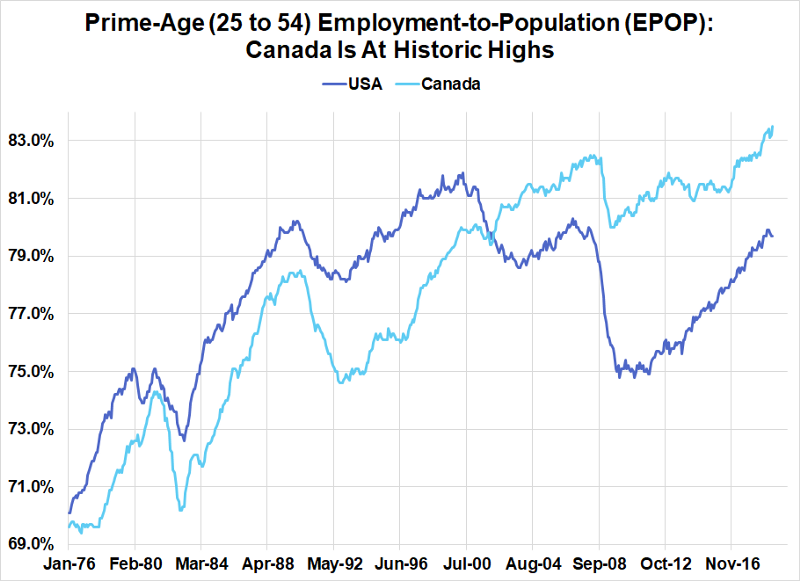 Like Bloomberg's Five Things? Subscribe for unlimited access to trusted, data-based journalism in 120 countries around the world and gain expert analysis from exclusive daily newsletters, The Bloomberg Open and The Bloomberg Close. Before it's here, it's on the Bloomberg Terminal. Find out more about how the Terminal delivers information and analysis that financial professionals can't find anywhere else. Learn more. | 


Post a Comment