| Welcome to your morning markets update, delivered every weekday before the European open. Good morning. The Federal Reserve is pointing towards an interest rate cut, European Union leaders are haggling over top jobs and the field of candidates to be U.K. prime minister has thinned down once again. Here's what's moving markets. Impatience Fed Chairman Jerome Powell opened the door to a rate cut as early as next month, removing language about the bank being patient in its stance and echoing his European Central Bank colleagues in saying uncertainty is plaguing the task of setting monetary policy. Bond markets appear to be telling the Fed to avoid any dawdling on those cuts and get on with the job. President Donald Trump is said to have told confidants only this week that he believes he has the authority to demote Powell from the top job, though the Fed chairman has indicated he has no intention of leaving the post. Roll On, Carney The ECB and the Fed have dominated proceedings in markets for the last couple of days, but there are plenty more central banks still to come. The Bank of England's latest decision has the potential to sound more hawkish than normal, particularly after inflation fell back to its target, though it's likely Brexit will drown out most of what the BOE does. Norway's central bank is likely to hike rates again as it continues to stand at odds with a global economic slowdown. The Bank of Japan is standing pat and Brazil's central bank also kept everything unchanged. European Haggling European leaders will meet to haggle over the top jobs at the European Commission and the ECB. One of the frontrunners for the latter, Bundesbank boss Jens Weidmann, sought to distinguish himself from the crowd by tweaking his position on a key policy under Mario Draghi. France is also leaning towards getting the commission job, potentially opening up the path for Weidmann to replace Draghi. Race for Second Rory Stewart became the latest contender in the race to lead the Conservative Party to be eliminated from the contest on Wednesday and all the focus now, given the huge lead Boris Johnson has built, is on who will battle him in the final two. The field will be cut to three on Thursday and then to the final pairing a day later. Backers of Johnson are said to be war-gaming an early election in the U.K. if he does indeed become prime minister. That might please Chancellor of the Exchequer Philip Hammond, who has said whomever wins will likely have to consider a new election or, of course, a second referendum. Coming Up... U.S. Treasuries extended gains following the Fed decision, with the dollar weaker and gold prices soaring. Asian stocks were mixed and European futures are pointing to a positive open. Data showing tighter U.S. oil supplies has also given crude prices a bump. Canadian Prime Minister Justin Trudeau is set to meet with Donald Trump to discuss trade and Huawei Technologies Co. We'll also get the ECB's economic bulletin, retail sales out of the U.K. and U.S. jobless claims later in the day. What We've Been Reading This is what's caught our eye over the past 24 hours. And finally, here's what Mark Cudmore's interested in this morning The U.S. 2s-30s rates curve is screaming that a recession is coming soon, if the last 20 years is any guide, and that Fed easing won't make a difference. The only two times that a steepening has sent the gap between 2-year yields and 30-year yields past 70 basis points this century, a recession has officially started within four months. And both occasions also coincided with the start of the only multi-year rate cutting cycles of this era. In 2001, the steepening to this level occurred within 24 hours of the January 3 Fed meeting that launched a 550 basis points rate-cutting cycle that lasted more than two years. The associated recession began in March. In August 2007, this situation was seen weeks before the Fed began a 500 basis points rate-cutting cycle that lasted little more than a year. A recession still arrived four months later. History may not repeat, but it does rhyme. The Fed is expected to next month begin only its third easing cycle of this century. Will the associated recession officially come this year or next? 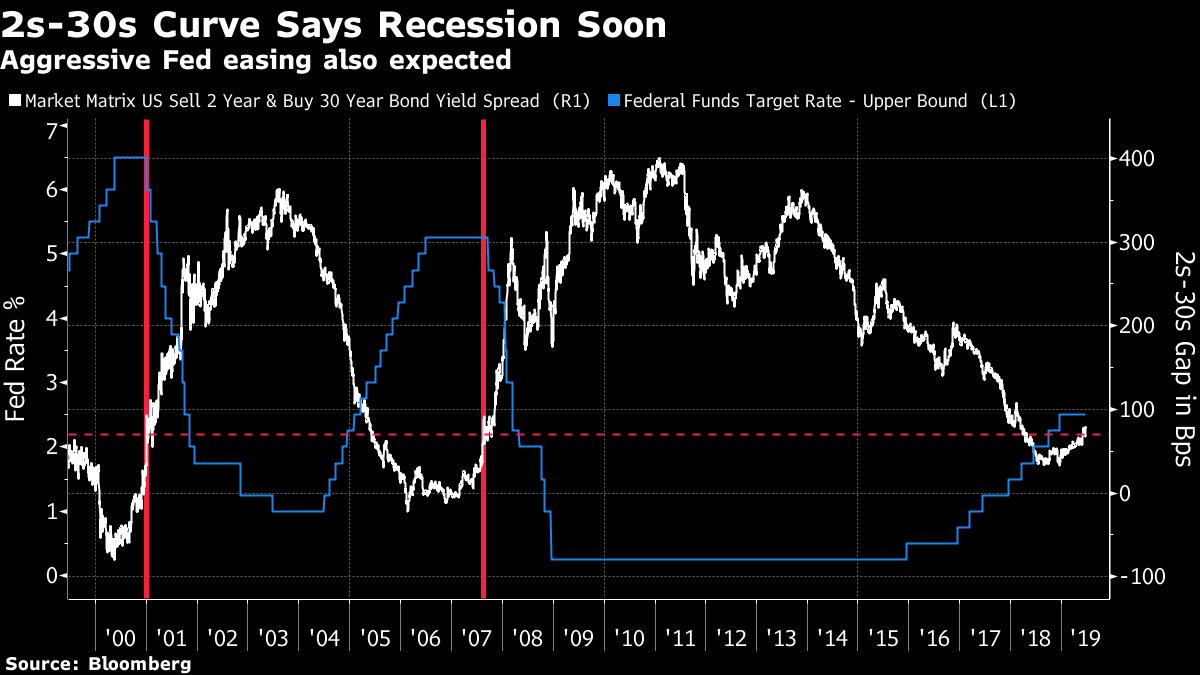 Mark Cudmore is a Bloomberg macro strategist and the Managing Editor of the Markets Live blog. Bloomberg Terminal users can follow him there at MLIV <GO> Like Bloomberg's Five Things? Subscribe for unlimited access to trusted, data-based journalism in 120 countries around the world and gain expert analysis from exclusive daily newsletters, The Bloomberg Open and The Bloomberg Close. Before it's here, it's on the Bloomberg Terminal. Find out more about how the Terminal delivers information and analysis that financial professionals can't find anywhere else. Learn more. | 


Post a Comment