| Welcome to your morning markets update, delivered every weekday before the European open. Good morning. Millions hit the streets of Hong Kong in further protests, debate about central bank policy will be the order of the day and Donald Trump wants credit for the economy. Here's what's moving markets. 2 Million As many as 2 million people filled the streets of Hong Kong on Sunday calling for Hong Kong Chief Executive Carrie Lam to withdraw the controversial extradition bill, rather than just suspending it, and resign. But the existential threat that Hong Kong faces – and the likelihood that further bills will materialize to chip away at freedoms its residents enjoy – is not yet gone. Asian stocks were mixed as markets await the flurry of central bank decisions due this week but big Asia-focused banks and luxury goods merchants are unlikely to be thrilled that the protests are still raging. ECB Debates The European Central Bank's forum will take place in Sintra, Portugal, on Monday and one can expect much discussion and debate about the policy outlook. There's been plenty to chew over already. Vice President Luis de Guindos said the ECB will act should inflation expectations deteriorate and Governing Council member Ewald Nowotny says he favors the bank having more flexibility in reaching its inflation target and that it's too early to judge the recent dip in inflation expectations. Keep one eye on Japan too, with slowing inflation expected to push bonds yields even lower, and China's central bank and its "tremendous" toolkit to tackle a slowing economy. 'Epic' Crash President Donald Trump wants credit for how the U.S. economy is performing, even if looking under the surface paints a less rosy picture than a first glance might, and warned that if he's not re-elected, there will be an "epic" stock market crash. Bond investors have certainly had a bullish period, but some watchers are warning the run may not continue through the Federal Reserve meeting this week, a Fed that at least one person thinks could have a different boss if Trump is indeed put back into office in 2020. Iranian Tensions Oil markets have been contending with seriously choppy waters recently. Increasing U.S. tensions with Iran following the tanker incident last week are showing no signs of cooling off, with Secretary of State Mike Pompeo pledging U.S. protection for shipping in the Gulf and Iran planning a further retreat from the terms of its nuclear deal this week. On the OPEC side of the oil conundrum, Saudi Arabia hopes the cartel will agree to further supply cuts at its meeting next month with a view to helping balance supply and demand dynamics in the second half. Oil prices were a little higher on the prospect of those output cuts. Coming Up... More barbs are likely to be traded among those vying to lead the U.K.'s Conservative Party following a first debate that was skipped by front-runner Boris Johnson, who was represented by an empty lectern. The field is going to be thinned down further as the week progresses. The Paris Air Show also gets under way with much focus expected on Boeing Co.'s crisis surrounding its 737 Max jet and Airbus SE looking to capitalize on home-court advantage. Public hearings are also due to start in the U.S. on the next round of tariffs proposed on Chinese goods. What We've Been Reading This is what's caught our eye over the weekend. And finally, here's what Mark Cudmore's interested in this morning Can you look at data yourself or do you need an interpreter? Your answer may define your global economic outlook. It also may explain why global equity markets linger not far from record highs, while global bond markets appear to be pricing a severe growth slowdown. According to the consensus forecasts on Bloomberg, the 2019 GDP outlooks for the U.S., the Eurozone and China have all improved over the past two months! That may explain stock market bullishness as equity investors are used to trusting the macro inputs of economists. Bond traders need to try to act way ahead of economists and so get used to understanding and interpreting data themselves. The eco surprise indexes for the U.S. and the euro area have remained in negative territory in recent months, undermining the upgrade in economists' growth forecasts. The slowdown in China data has been similarly notable. Never mind the data, it seems remarkable that the escalation in the U.S.-China trade war - and increased tariffs from both sides - has somehow boosted the growth outlooks for the world's three major economic zones. Stocks traders may prove justified trusting the economists, but my money is on the bond traders. 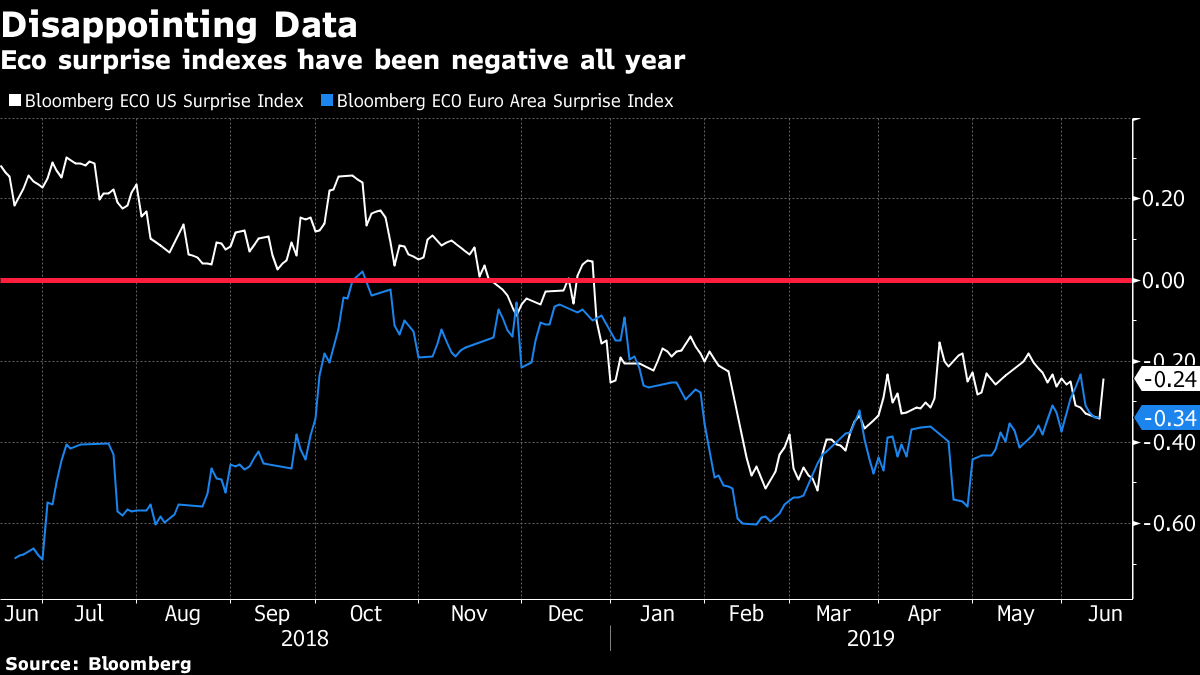 Mark Cudmore is a Bloomberg macro strategist and the Managing Editor of the Markets Live blog. Bloomberg Terminal users can follow him there at MLIV <GO> Like Bloomberg's Five Things? Subscribe for unlimited access to trusted, data-based journalism in 120 countries around the world and gain expert analysis from exclusive daily newsletters, The Bloomberg Open and The Bloomberg Close. Before it's here, it's on the Bloomberg Terminal. Find out more about how the Terminal delivers information and analysis that financial professionals can't find anywhere else. Learn more. | 


Post a Comment