| This is Bloomberg Opinion Today, a consumer price index of Bloomberg Opinion's opinions. Sign up here. Today's Agenda 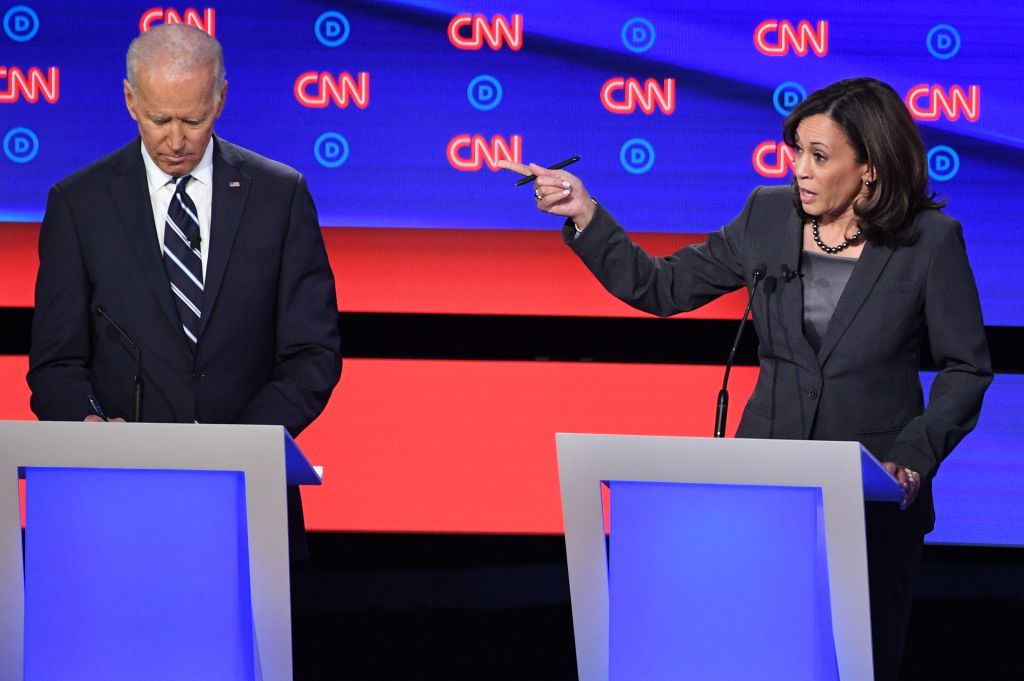 She's not afraid to speak her mind. Photographer: JIM WATSON/AFP/Getty Images Joe Biden Makes the Right Call The choice of a running mate can say a lot about how a potential future president will govern. As President Barack Obama said yesterday, it's "the first important decision a president makes." That's why Joe Biden's pick of Senator Kamala Harris to be his running mate offers reasons to be optimistic about a Biden presidency. Critics on the right and left have qualms about Harris, as they would about almost any politician who can fog a mirror. But nobody doubts she's among the most qualified of the available candidates to be a heartbeat away from the presidency. Perhaps more tellingly, she has also never held back on criticizing Biden; President Donald Trump described her as "nasty" and "disrespectful" to Biden, which is why he said Biden's pick "surprised" him. But that only puts the contrast between Biden and the current White House occupant into ultra-high-definition clarity, writes Bloomberg LP founder Michael Bloomberg. One values competence and staffers who disagree with him. The other very famously and disastrously does not. "Over the past four years," Mike writes, "we have seen what happens when a vice president insists that a naked emperor is fully clothed." Biden's pick of Harris is also the latest example of the former vice president's superpower, which is an ability to unerringly navigate his way into the middle of the Democratic Party mainstream, writes Jonathan Bernstein. He could have veered further to the left or swung wildly to the right by picking, say, Mitt Romney. Instead he went with a moderately liberal woman, the heart of the party's power center these days. And let's stop for a moment and appreciate what it says about this country that the safe, boring veep pick is a woman of color. As Ramesh Ponnuru writes, a safe pick is the one you make when you're solidly in the lead and don't want to rock the boat. That this happens to describe the outspoken daughter of Indian and Jamaican immigrants is another reason for optimism. Further Election Reading: Trump seems to think he can blame the Democrats for blowing up the economy. That won't work. — Jonathan Bernstein Inflation: Still Not a Thing For at least the past few recessions, a loud contingent of worriers has worried that stimulus will fuel hyperinflation, leaving Americans pushing wheelbarrows full of nearly useless dollars to the 7-Eleven. This recession is no different. And those worriers got a thrill today, with a report that "core" consumer price inflation last month posted its biggest gain since 1991. But don't break out your wheelbarrow just yet. The pandemic is squeezing supplies of many consumer goods, leading to temporary shortages and price spikes, writes Conor Sen. These will abate as the system adjusts. In fact, all over the world, despite central bankers making all the money printers go brrr, there is little evidence of lasting inflation taking root, writes Dan Moss. The real risk is still deflation, a nightmare that will make inflation look like a pre-pandemic trip to Disneyland in comparison. Further Inflation Indicator Reading: Time for Some Economic Creativity The world is still in the grips of a ferocious recession, after all, one that's particularly hard on people in the developing world. Central-bank largesse is nice, but takes too long to trickle down to deeply impoverished people who aren't sure of their next meal. Much quicker relief has been provided in this crisis by stimulus payments zapped directly to mobile devices, notes Bloomberg's editorial board. The developed world should help developing nations expand and strengthen this system to help more people more quickly. Of course, the U.S. could use some creative economic thinking too. Low- and middle-income Americans can live pretty precarious lives themselves, and we're learning the social safety net isn't always as sturdy as it should be. Family wealth can help people ride out crises more easily, writes Noah Smith. He argues America needs a government wealth program, maybe with "baby bonds" or homebuying assistance, to help more people build wealth cushions. Lebanon's Opportunity Never let a good crisis go to waste, the old saying goes. When you've got three crises happening at once, as Lebanon does ... well, imagine the opportunities. In this case, the country might finally be able to shake off the destructive squeeze Hezbollah has had on its politics for years, writes Hussein Ibish. The government's mishandling of the pandemic, the economy and the very large quantity of explosives that leveled part of Beirut may finally fuel enough public rage to change Lebanese politics for good. Neighboring Israel may be tempted to intervene, to give Hezbollah a helpful nudge over the cliff, writes Zev Chafets. It would be wise to resist. Telltale Charts The U.K. economy is in a grim stretch, but there are some very specific reasons to be optimistic, write Mark Gilbert and Andrea Felsted. 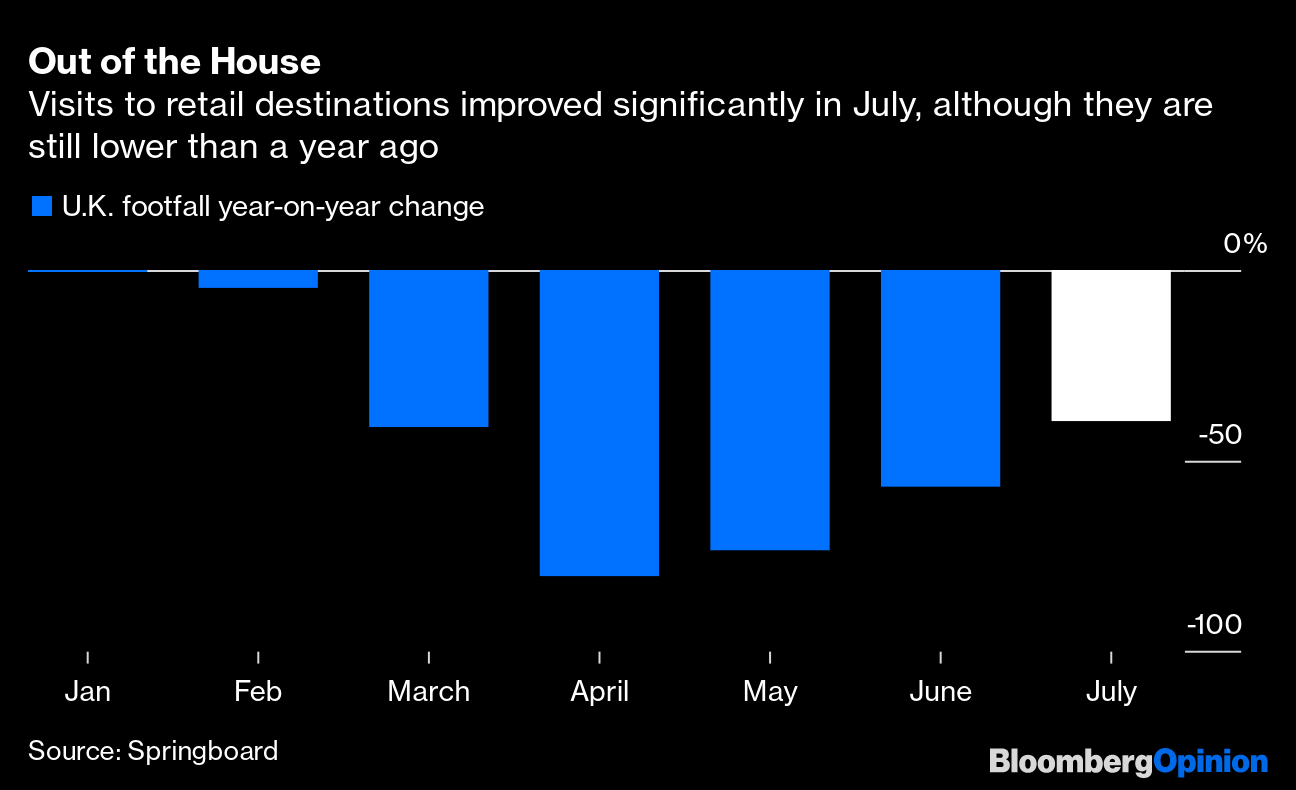 Further Reading In college football, common sense and safety are triumphing over politics and money, for now. — Joe Nocera Trump's bridge-burning leaves America alone in trying to keep arms from Iran. — Bobby Ghosh People make some common financial mistakes during a recession. Here's how to avoid them. — Erin Lowry For better or worse, Sumner Redstone was the spiritual progenitor of today's Big Tech moguls. — Tara Lachapelle ICYMI A Hudson Valley town has the fastest-rising home prices in America. Big Brother is watching traders at home. Nobody wants this lifesaving car technology. Kominers's Conundrums Hint If you haven't yet figured out the secrets of our mysterious maps, first you should try to identify some of the locations. In this case, they're all cities — and it might be best to focus on the less well-known ones, as those are more likely to give away the pattern. Then, when you're sizing up the first map, you should note there is exactly one dot per state. But they're not (all) state capitals, so what could they be? For the second map, I hinted in the column that it's not about the numbers; rather, we've plotted some sort of event that happens around the world. But what could it be? I'll tell you this much: The first one was in 1959. We'll extend answer collection for this puzzle through Thursday. — Scott Duke Kominers Kickers There's no sign of an insect apocalypse in the U.S. yet. 70% of Americans say they can't work without a home Internet connection. Ban handshakes forever. Idleness is more valuable than ever. Note: Please send idle time and complaints to Mark Gongloff at mgongloff1@bloomberg.net. Sign up here and follow us on Twitter and Facebook. | 




Post a Comment