| U.S. President Donald Trump receives legislation supporting Hong Kong protesters. Billionaire Louis Bacon calls time on the hedge fund business. Rich Hongkongers plan escape routes for their cash. Here are some of the things people in markets are talking about. Moral Authority House Speaker Nancy Pelosi sent Donald Trump legislation supporting Hong Kong protesters, and the president is expected to sign the bill into law despite Chinese warnings of retaliation. Trump plans to sign the bill, according to a person familiar with the matter, even as his administration tries to finalize the first phase of a long-awaited trade deal with China. Pelosi acknowledged the economic risks of angering the world's largest emerging market, but she said if the U.S. doesn't "speak up for human rights in China because of commercial issues, we lose all moral authority to speak about human rights anywhere in the world." Escape Route Top bankers say Hong Kong's wealthy are opening more offshore accounts to ensure they have an emergency escape route for their cash if the city's civil unrest worsens. So far, the money has largely been staying put, the heads of UBS Group AG, Credit Suisse Group AG and Standard Chartered Plc said in interviews at the New Economy Forum in Beijing. While Goldman Sachs Group Inc. isn't seeing any change of behavior among major financial clients, "the situation needs to be resolved" soon, CEO David Solomon said. The economy of the former British colony is reeling, with retailers, restaurants and hotels cutting wages or letting staff go to survive the downturn in tourism. Delisting Chinese Firms? Former U.S. Treasury Secretary Hank Paulson said calls to oust Chinese companies from American stock indexes was contrary to the foundations of capitalism, as he warned against the dangers of decoupling the world's two largest economies. Paulson, who's now chairman of the Paulson Institute, told Bloomberg's New Economy Forum in Beijing that moves to reduce ties between the U.S. and China would weaken American leadership and New York's leading role in finance. He said less cooperation between Washington and Beijing would also make it more difficult to tackle another financial crisis like the one he was forced to manage as treasury secretary in 2008. 'Giant' Calls Time Billionaire Louis Bacon is effectively quitting the hedge-fund business after several years of poor performance, bringing an end to his three-decade run near the pinnacle of global finance. Bacon, 63, will return outside investors' money in its three main Moore Capital Management funds and step back from trading, he said Thursday in a letter to clients. The move caps a storied career that has traced the arc of modern finance, from the swashbuckling money managers who made fortunes in the 1980s and 1990s to today's era of computer-dominated trading. "Louis Bacon will go down as one of the giants of our industry," said legendary trader Stan Druckenmiller. "He was one of the earlier innovators in the genre of global macro. To not only survive, but thrive in our industry for 30 years is an outstanding achievement." Markets Steady Asian stocks looked set for a modest rebound Friday as traders awaited further details on U.S.-China trade discussions. Treasuries and U.S. shares dipped. Futures pointed higher in Japan, Hong Kong and Australia. The S&P 500 Index fell for a third day, the longest losing streak in almost two months, but remained within 1% of a record high. The yield on 10-year Treasuries climbed to 1.77% while the dollar edged higher against most G-10 counterparts. Elsewhere, oil climbed to a nine-week high as traders latched on to optimistic signals on trade. Gold slipped. What we've been reading This is what's caught our eye over the last 24 hours. And finally, here's what Tracy's interested in this morning Here at the New Economy Forum in Beijing, I spoke to the head of one of China's largest asset managers about the prospect of China opening up to foreign capital. For the time being, we agreed, benchmark index providers like MSCI are basically the arbiters of the speed at which foreign capital flows into China. They decide how much of China's bonds or stocks get included. 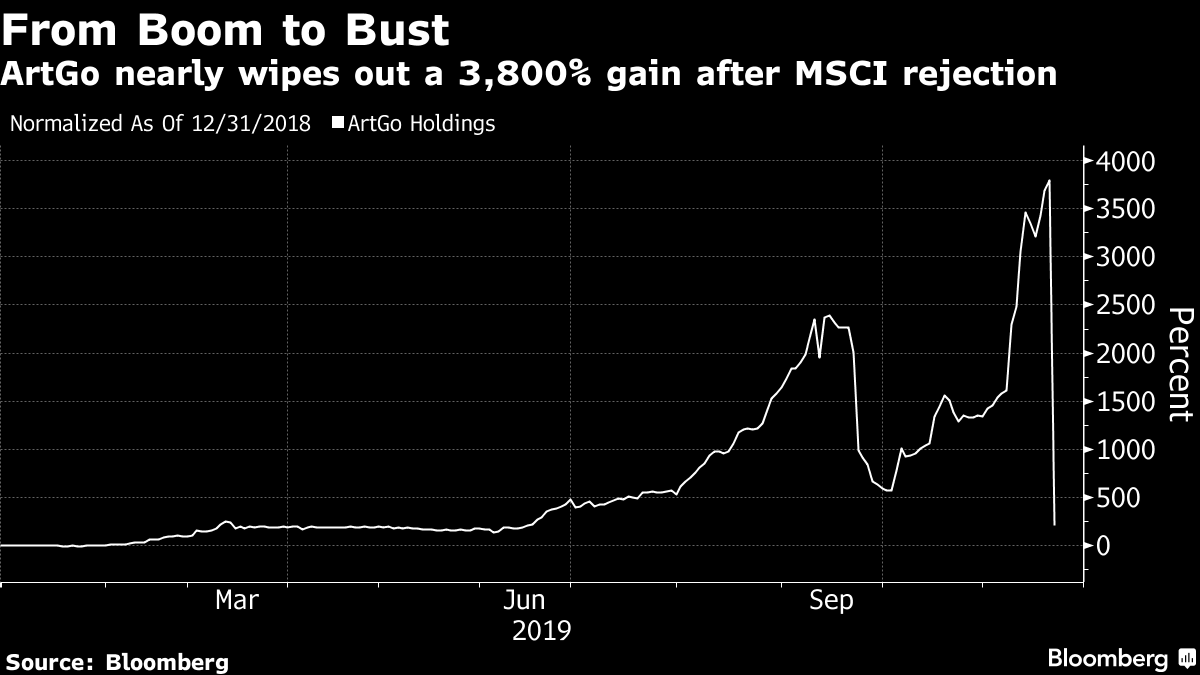 But the funny thing is that benchmark index providers would likely refuse that label. They often describe their role as merely reflecting the needs and desires of investors by holding up a mirror up to the market. The problem, obviously, is that their decisions can end up affecting that same market. For the latest instance of just such a dynamic, check out this story from my colleagues Jeanny Yu and Kiuyan Wong. It's about a marble company called ArtGo Holdings, whose shares surged about 3,800% this year — spurring MSCI to announce its intention to include the stock in its indexes. But on Thursday, MSCI suddenly scrapped those plans, citing concerns about the "investability" of the stock. Shares promptly plunged 98%. (Disclosure:Bloomberg LP, the parent company of Bloomberg News, owns the Bloomberg Barclays-branded bond indexes, the most widely followed measure of fixed-income performance worldwide.) You can follow Bloomberg's Tracy Alloway at @tracyalloway. The best in-depth reporting from Asia Pacific and beyond, delivered to your inbox every Friday. Sign up here for The Reading List, a new weekly email coming soon. Before it's here, it's on the Bloomberg Terminal. Find out how the Terminal delivers information and analysis that financial professionals can't find anywhere else. Learn more. | 


Post a Comment