| Want the lowdown on what's moving European markets in your inbox every morning? Sign up here.
Good morning. Investors globally continue to dissect conflicting statistics on the economy, oil's having a decent week, the health of German leader Angela Merkel is gaining more and more media attention and Bloomberg's found the perfect drink for your weekend. Here's what's moving markets. Shaky Sentiment in equities is notably shaky. Asian markets were mixed overnight as an unexpected contraction in Singapore's economy in the second quarter sent a warning shot on the impact of ongoing trade tensions. The region has also been digesting Trump's tweets from Thursday complaining that China hasn't increased its purchases of American farm products, a key component of last month's discussion on broader trade. Keep an eye out for China trade balance numbers due out this morning. Barry Oil's headed for its biggest weekly gain in three as simmering Middle East tensions, shrinking U.S. crude inventories and a storm in the Gulf of Mexico – called Barry -- all conspire to threaten the supply outlook. Meanwhile, Iran's attempt to block the passage of a British tanker in the Persian Gulf has ratcheted up tension in the oil-rich region. Here's a good explanation of exactly what's going on there. Data Dominates You can try, but you just can't fight data. U.S. President Donald Trump may have won his battle for lower rates after Federal Reserve Chairman Jerome Powell indicated a strong possibility of an impending cut, but the war might have just begun after inflation was shown Thursday to have risen more than expected in June. Now what? The dollar pared Thursday's gain overnight. Merkel's Health There's some focus on the health of Angela Merkel after the German chancellor opted to sit through a ceremony on Thursday, a day after she suffered her third bout of shaking in less than a month during a similar event. The episode has raised questions over whether she'll continue to lead Europe's largest economy until 2021, when an election is due. Here's a guide to how Germany would find a new leader if the 64-year-old were to stand down early. Coming Up... Bank of England Governor Mark Carney, who's declining to comment on his interest in becoming head of the International Monetary Fund, and also policy maker Gertjan Vlieghe, speak in London, just as one investment bank is predicting policy easing this year. Data due today includes euro-area and Turkish industrial production, as well the U.S producer price index after the higher-than-expected June CPI mentioned above. Roger Federer and Rafael Nadal meet at Wimbledon later for the first time since their truly epic 2008 final. What We've Been Reading This is what's caught our eye over the past 24 hours. And finally, here's what Cormac Mullen is interested in this morning Increased chatter about possible U.S. currency intervention is alarming strategists across Wall Street thanks to repeated complaints from President Donald Trump about the foreign-exchange practices of other countries. The U.S. leader tweeted last week that Europe and China are playing a "big currency manipulation game," and called on the U.S. to "MATCH, or continue being the dummies." America last intervened in FX markets in 2011 when it stepped in with international peers after the yen soared in the wake of the devastating earthquake in Japan, but it hasn't tried to forcibly weaken the dollar since 2000. Beyond the obvious currency market implications, equity investors are also closely watching affairs, with some getting more excited than others. Emerging market stocks are the most negatively correlated to moves in the Federal Reserve's trade-weighted broad dollar index, according to data compiled by Bloomberg. Alongside U.S. equities, this means they stand to benefit most from any dollar weakness, with less of an impact seen in European and Japanese markets. EM shares have been underperforming their developed market counterparts this year. As strategists at Citigroup wrote in a note to clients Thursday, a slump in the greenback could ``supercharge'' a bid for the lagging asset class. 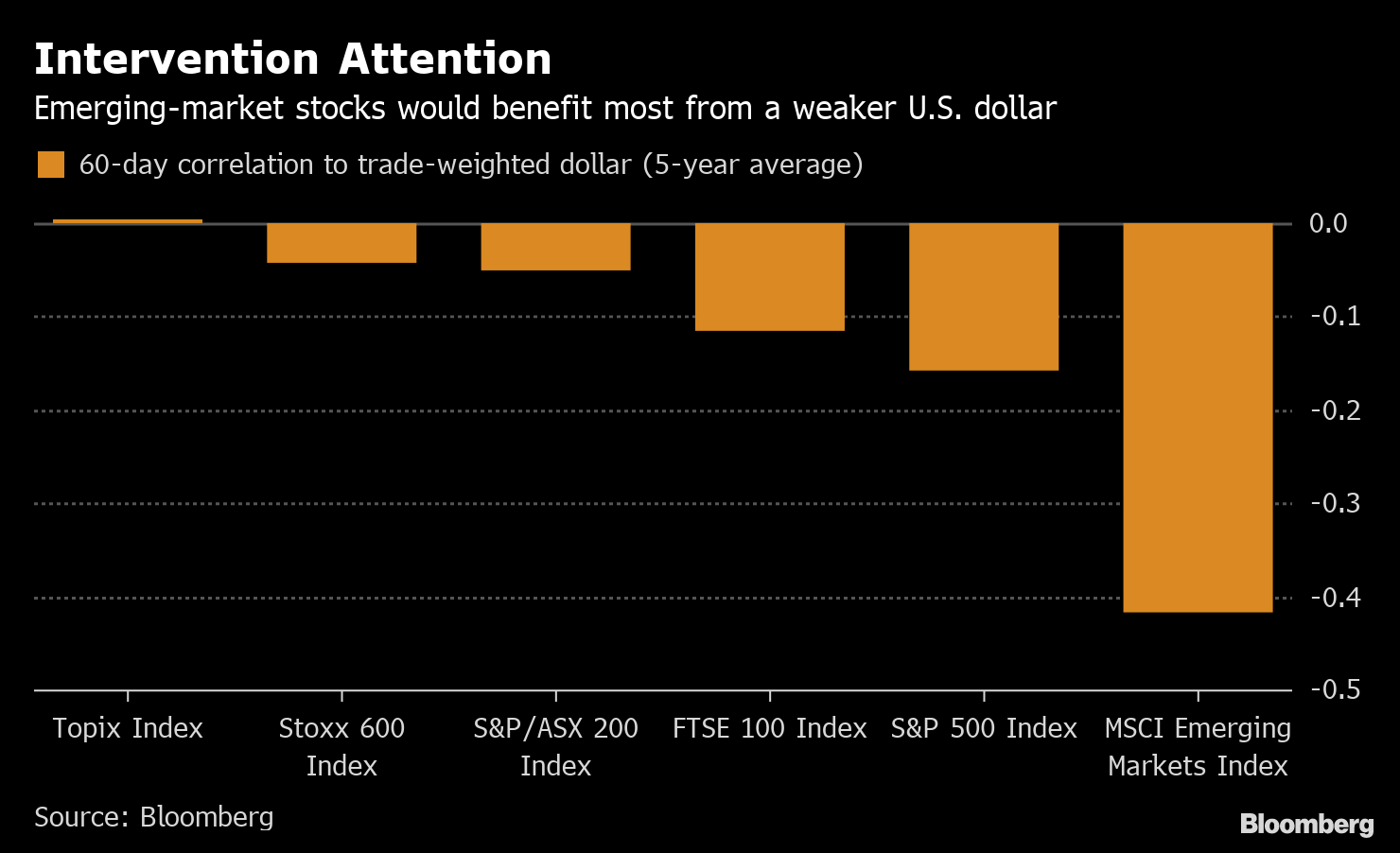 Cormac Mullen is a Cross-Asset reporter and editor for Bloomberg News in Tokyo. Like Bloomberg's Five Things? Subscribe for unlimited access to trusted, data-based journalism in 120 countries around the world and gain expert analysis from exclusive daily newsletters, The Bloomberg Open and The Bloomberg Close. Before it's here, it's on the Bloomberg Terminal. Find out more about how the Terminal delivers information and analysis that financial professionals can't find anywhere else. Learn more. | 


Post a Comment